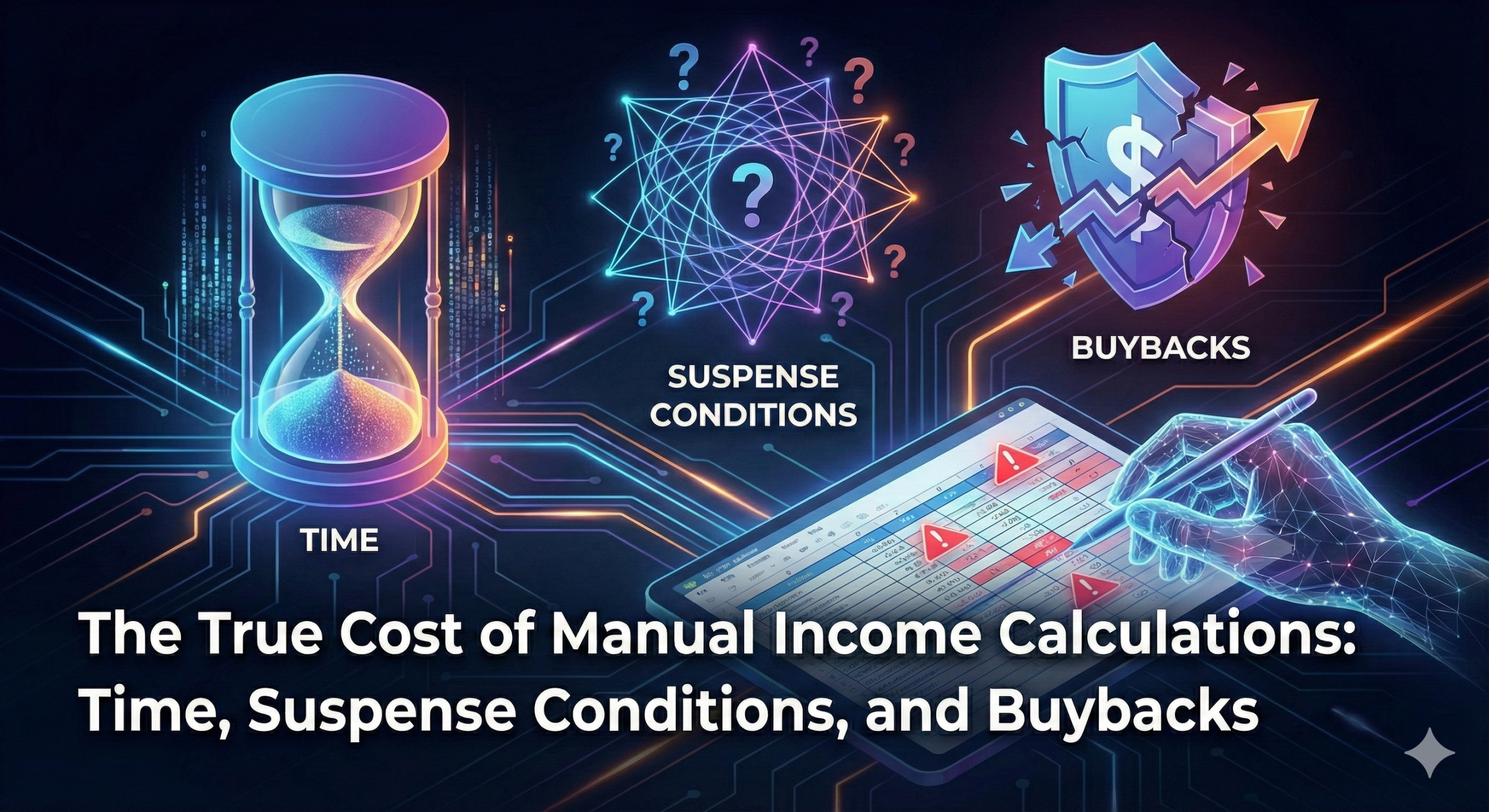
The True Cost of Manual Income Calculations: Time, Suspense Conditions, and Buybacks
Most lenders know manual income work is “not ideal.” Few can see the full price tag: wasted underwriter hours, suspense conditions that kill cycle time, and quiet buyback risk. When you add it up, manual income is one of the most expensive line items in your loan manufacturing process.
1. What “manual income calculations” really mean today
Manual income work is not just “no AI.” It’s any situation where your people are still piecing together income in spreadsheets or calculators, even if you have document AI in place.
In most organizations, the process looks like this:
- Docs arrive: pay stubs, W-2s, tax returns, bank statements, LES, SSA letters, etc.
- Processors (or LOs) build a first-pass income worksheet, usually in Excel.
- Underwriters rebuild or heavily adjust that worksheet to be comfortable signing off.
- Each person applies their own interpretation of FHA, VA, Fannie, Freddie, and overlays.
- Conditions and notes are written manually for every file.
Even if you use generic OCR or “document AI” to pre-fill some LOS fields, if your team still recalculates income by hand, you’re paying the full cost of manual income.
2. Direct time and headcount cost
Start with what’s easiest to see: time. Underwriters and processors are your most expensive operational resources. Every minute spent on manual income is a minute not spent on closing more loans or managing risk.
2.1 Underwriter time
For many lenders, underwriters spend 30–60 minutes per file on income alone:
- Reviewing each document and checking for completeness.
- Rebuilding calculations from scratch “just to be sure.”
- Reconciling differences between their view and the LO/processor worksheet.
At 30–60 minutes per file, an underwriter’s daily capacity is defined more by income complexity than by the actual credit risk of the loans.
2.2 Processor and LO time
Upstream, processors and LOs are also spending hours:
- Guessing income for pre-quals and pre-approvals.
- Building their own spreadsheets and “templates.”
- Chasing borrowers for missing documents only after discovering gaps late.
This is time that could be spent clearing conditions earlier, communicating with borrowers, or moving more files through the pipeline.
2.3 The compounding effect
One file might not seem like a big deal. But across a month:
- 100 files x 45 minutes per file = 75 hours of underwriter time.
- Scaled to a year and multiple underwriters, this is thousands of hours.
Those hours represent either higher fixed cost (more headcount) or lower throughput (less volume) — and usually both.
3. Suspense conditions: the hidden tax on cycle time
Time spent on income is only the start. The bigger cost often shows up as suspense conditions and rework.
3.1 How manual income creates suspense
When each LO, processor, and underwriter uses slightly different logic, you inevitably get:
- Files that are “approved” internally but challenged by investors.
- Late-discovered gaps in documentation or history.
- Income that had to be recalculated after a second set of eyes.
That turns into suspense conditions that stop the file midstream, tying up capacity and delaying closing dates.
3.2 The cost of rework and delays
Suspense has a direct and indirect cost:
- More touches per file: underwriters and processors revisit the same loan multiple times.
- Longer cycle times: more days in the pipeline means higher per-loan cost.
- Borrower and partner frustration: “one more doc” and shifting timelines hurt referrals.
Even if the loan eventually closes, the effective cost per funded loan rises as you add touches and days in process.
4. Buybacks, cures, and defect risk
The most expensive outcome of manual income is not time or suspense. It’s defects that show up after the loan is sold.
4.1 Where income defects hide
Common manual-income issues that turn into post-close pain:
- Inconsistent treatment of overtime and bonus income.
- Insufficient history for variable or self-employed income.
- Misclassification of one-time vs. recurring income.
- Over-reliance on the most recent pay period in declining situations.
These are exactly the kinds of issues investors and QC teams uncover during audit — especially when multiple underwriters use slightly different interpretations.
4.2 Financial impact of cures and buybacks
Not every income defect results in a full repurchase. But many result in price adjustments, cures, or extra reserves. And when a repurchase does happen, the cost can wipe out the profit from dozens of clean loans.
When you don’t have a standardized, auditable income and conditions engine, you carry a quiet but meaningful tail risk that grows with volume.
5. Human factors: burnout, inconsistency, and training drag
Manual income also comes with real human costs that eventually show up in your P&L and retention stats.
5.1 Burnout and error risk
Income work is cognitively heavy. Staring at tax returns, bank statements, and pay histories all day is draining. When underwriters are buried in manual math:
- Error rates naturally rise late in the day or at month-end rush.
- Underwriters spend less time on true risk assessment.
- Engagement drops, and attrition risk goes up.
5.2 Inconsistent training and onboarding
Training new staff on manual income is slow and variable:
- “Shadow this senior underwriter and copy their spreadsheet.”
- Multiple versions of “the right way” circulate in the org.
- New hires take months to reach full productivity.
Without a common engine and report structure, you are effectively retraining your income process from scratch every time you hire.
5.3 Overreliance on a few experts
In most shops, a small group of “income gurus” handle the worst files: self-employed, reverse, multiple businesses, niche products. If they leave or hit capacity, the organization feels it immediately.
That concentration of knowledge is a business risk that manual processes make worse.
6. A simple model for the cost of manual income
You don’t need a complex model to see the impact. Even a rough calculation tells the story.
Imagine a mid-size lender with:
- 4 underwriters focused on retail/wholesale.
- Each underwriter handles ~70 files per month.
- Average of 45 minutes of income work per file.
That’s roughly 210 hours of underwriter time per month spent solely on income (4 UWs × 70 files × 45 minutes / 60).
Now add the hidden layers:
- Processor time spent building initial worksheets.
- Suspense files that require a second or third UW touch.
- Exceptions and overrides that QC has to track manually.
- Occasional cures or price adjustments tied to income issues.
When you assign a realistic cost per underwriter/processor hour, plus a small reserve for income-related defects, it becomes clear that income is one of the highest ROI areas for targeted automation.
7. Moving from manual income to an income engine
The answer isn’t “throw out document AI” or “replace underwriters with a black box.” It’s to add a dedicated income & Smart Conditions engine that standardizes how income is calculated and reviewed.
A realistic path looks like this:
- Step 1 – Pick a pilot segment
Start with FHA/VA, self-employed borrowers, or one high-volume channel. Run all income through the engine and compare results with your current process. - Step 2 – Align underwriters
Involve underwriters in validating guideline logic and report structure. Make them co-owners, not passive recipients. - Step 3 – Standardize reports and conditions
Use the engine’s income report and Smart Conditions as the single source of truth for that segment. - Step 4 – Roll out by product and branch
Expand coverage across products, channels, and branches once trust and metrics are in place. - Step 5 – Measure, then scale
Track time per file, touches, suspense rates, and income-related defects before and after. Use the data to guide further investment.
Document AI can help you read documents. A vertical income engine helps you change your economics by cutting manual work, standardizing decisions, and reducing risk.
Rapidio is designed exactly for this: turning every income file into a consistent, guideline-ready decision with Smart Conditions that your underwriters can trust and investors can audit.
Pick 20 recent loans and run them through Rapidio alongside your manual process. Compare time spent, conditions raised, and issues caught. See in real numbers what an income engine can change.