How to Use Rapidio to Standardize Income Across Branches and Channels
If you operate across multiple branches or channels (retail, wholesale, broker, correspondent), you’ve probably seen the same problem: the same borrower file can produce different income numbers depending on who touches it. That variance creates rework, suspense, inconsistent decisions, and unpredictable cost per loan. This post breaks down exactly how lenders use Rapidio to standardize income and conditions - and where the ROI shows up.
1. Why income variance happens across branches and channels
Variance isn’t because your people are bad - it’s because income is complex and the process is fragmented:
Different interpretations
Overtime, bonus, commission, multiple jobs, self-employed: rules vary by product and investor overlays.
Different tooling
Branches run their own spreadsheets, templates, and “tribal knowledge” playbooks.
Different incentives
Sales wants speed, ops wants cleanliness, UWs want defensibility - creating inconsistent behavior.
The result is predictable: more touches, more disagreement, more suspense conditions, and more time spent reconciling income instead of closing loans.
2. What “standardized income” really means
Standardized income is not “one number for every scenario.” It’s:
- One method to calculate qualifying income per guideline set (FHA/VA/GSE/Non-QM/reverse).
- One report format that every UW, processor, and QC reviewer understands.
- One condition language that can be applied consistently across branches.
- One audit trail explaining how the number was derived (math + rationale).
That’s what creates trust. And trust is what eliminates rework.
3. The Rapidio workflow: standardization without heavy change management
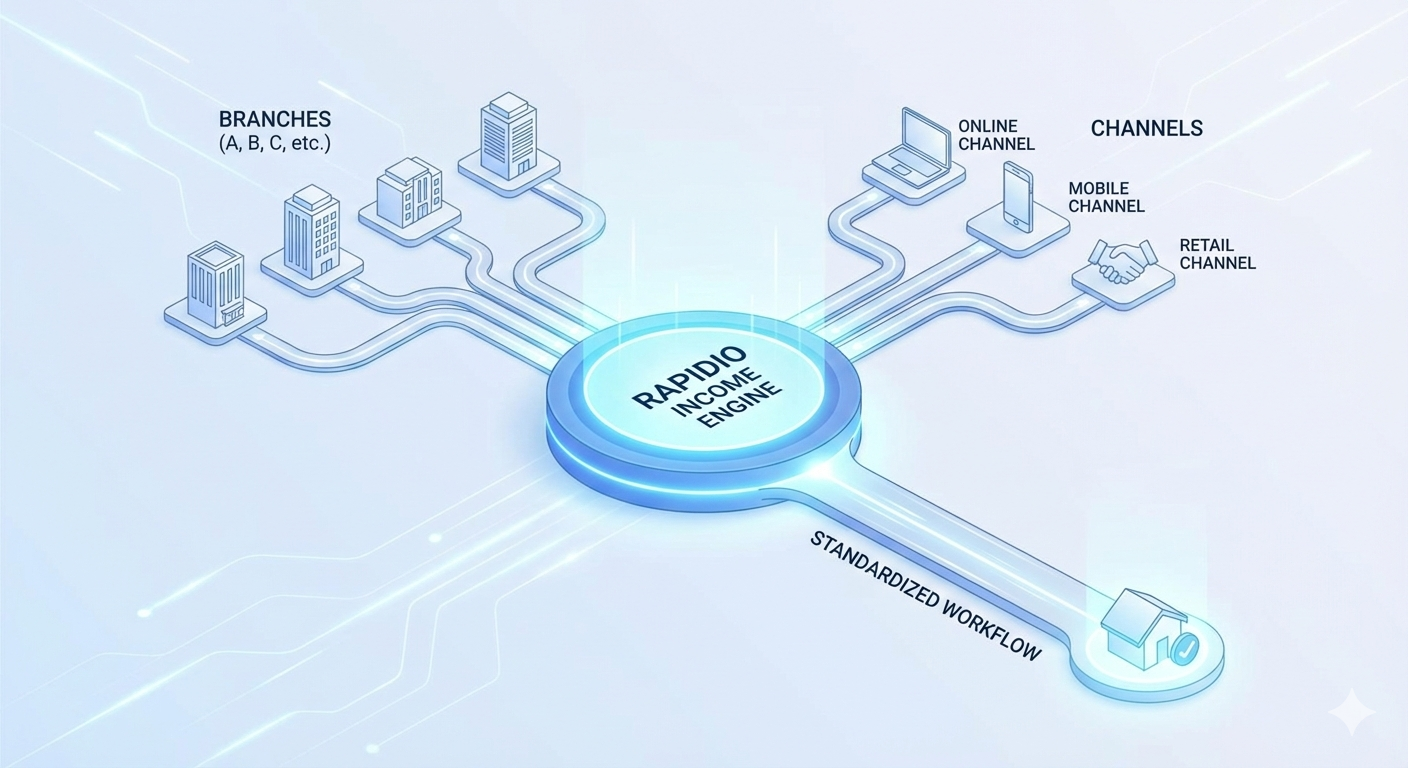
Rapidio is designed to standardize income outputs across teams without forcing you to rewrite your entire process. The workflow is simple:
Common intake
Files enter Rapidio via portal or API - same input, regardless of branch or channel.
Guideline-aware calculations
Income is calculated using the correct guideline pack + your overlays, with full transparency.
Smart Conditions generated
Conditions are standardized: missing docs, gaps, declines, stability checks, and consistency issues.
One report format for everyone
Underwriting, processing, and QC use the same report and the same “source of truth.”
The key is not that Rapidio “does AI.” The key is that it produces a consistent, auditable output that your teams can trust across branches - and that reduces the number of times anyone needs to reopen the file.
4. Where the ROI comes from (time, suspense, defects, capacity)
ROI shows up in four measurable places
Even small improvements compound quickly across volume and branches.
- Fewer underwriter minutes per file (UWs validate vs rebuild income)
- Lower income-driven suspense rate (conditions are caught earlier and more consistently)
- Fewer touches / re-review loops (less disagreement across teams)
- Lower defect / cure risk (auditable, standardized rationale reduces variance)
Leadership typically feels this as: higher capacity per UW, faster cycle times, and lower cost per loan - without hiring more people.
4.1 The “variance tax” (what you’re paying today)
When branch A calculates income differently than branch B, you pay a “variance tax”:
- Underwriters spend extra time reconciling differences.
- Processors chase documents later because conditions weren’t standardized upfront.
- Files get suspended more often (or for longer) due to inconsistent doc expectations.
- QC finds issues late because the rationale is not uniform.
4.2 The ROI math (simple way to estimate)
Here’s a simple framework:
- Take your average monthly volume (per channel or total).
- Estimate average UW minutes spent on income today.
- Estimate how many re-review touches are income-driven.
- Assign a loaded cost per hour for UW + processor time.
Standardizing income typically produces savings through minutes + touches + suspense days. Even conservative gains can translate into meaningful cost-per-loan reduction when multiplied across volume.
5. Implementation plan: pilot → playbook → scale
Standardization succeeds when it’s deployed like a production playbook, not a big-bang rollout:
- Pilot cohort (2 weeks): 20–50 loans across 2–3 branches or channels (include complex income).
- Align outputs: confirm report format, condition language, and guideline pack selection.
- Publish a playbook: “How we run income in this company” (one standard process).
- Scale by channel: expand to remaining branches once KPIs improve.
6. KPIs leadership cares about (and how to measure them)
To prove value, measure before and after:
- Income-related UW minutes per file
- Touches per file (income-driven re-reviews)
- Income-driven suspense rate + days in suspense
- Time to initial UW decision
- Time from conditional approval to CTC
- Income-related defects/cures
- Cost per loan (operations view: minutes × loaded cost)
When these metrics move in the right direction, standardization becomes self-funding.
Choose 2 branches (or 2 channels) and run a parallel test with Rapidio on 20–30 loans. We’ll help you compare variance, conditions, touches, and UW minutes - and quantify ROI quickly.