From Application to Clear-to-Close: Where Income Automation Cuts the Most Time
Every lender wants faster cycle times, but most “speed projects” focus on surface-level steps: collecting docs faster, pushing status updates, or adding more staff. The biggest time savings usually come from one place - income - because income touches almost every stage between application and clear-to-close (CTC).
1. Why income drives cycle time more than almost anything
Income is not just a calculation - it’s a gatekeeper. When income is uncertain, everything slows down: underwriting, conditions, document requests, and even pricing decisions.
It’s high-touch
Income usually triggers multiple back-and-forth loops between borrower, processor, and UW.
It’s inconsistent
Different people treat the same income differently - which creates rework and re-review.
It’s late-discovered
Many income gaps and declines are found late, causing last-minute conditions and delays.
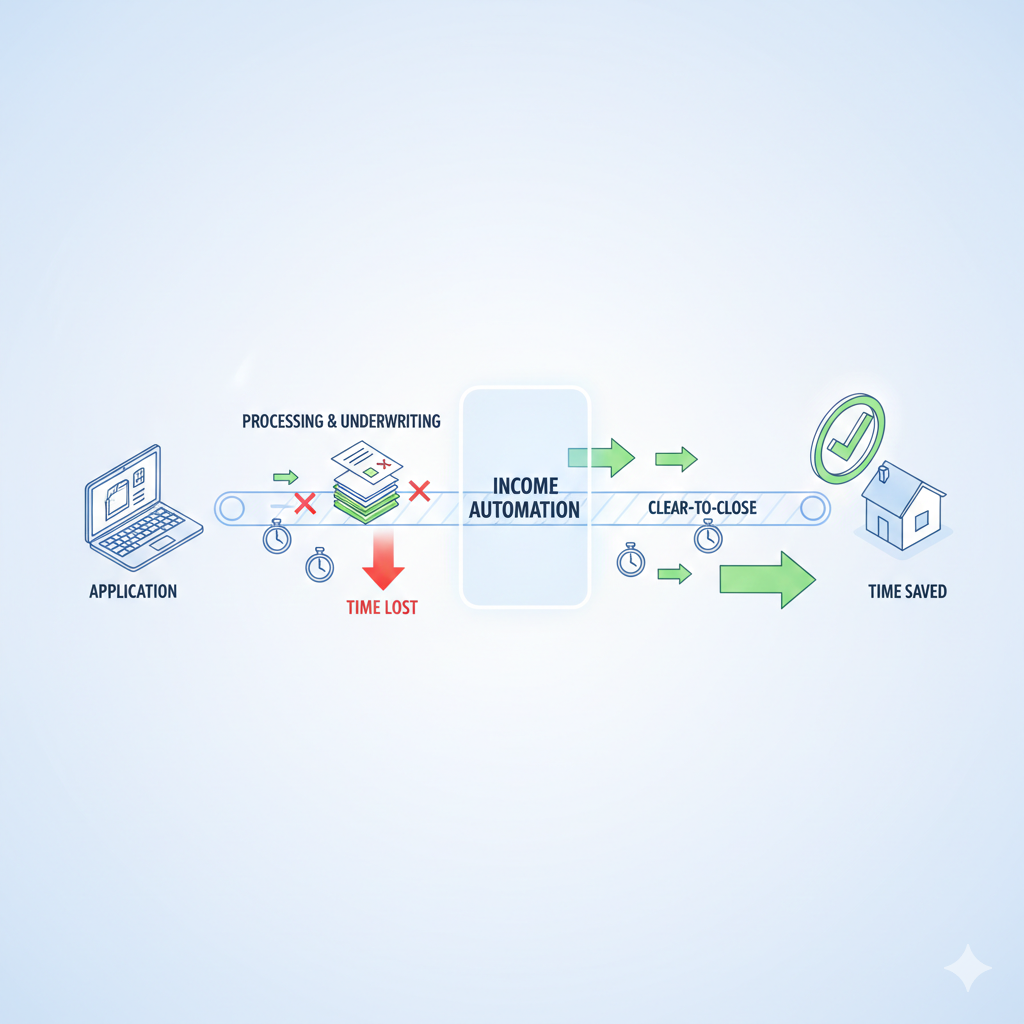
2. The application-to-CTC timeline: where time gets lost
Most loans don’t slow down because of one big problem - they slow down because of small delays that pile up: “one more pay stub,” “we need 24 months of bonus history,” “income declined,” “can’t use this job yet,” etc.
| Stage | Typical Time Leak (Income-related) | What Income Automation Changes |
|---|---|---|
| 1) Application / Pre-qual | LO estimates income; later UW disagrees → rework | Guideline-aware income estimate early + clear doc checklist |
| 2) Document collection | Docs arrive incomplete; issues discovered late | Smart Conditions identify missing items as soon as docs are uploaded |
| 3) Initial underwriting | UW rebuilds income from scratch; long queue time | UW validates a standardized income report instead of rebuilding |
| 4) Conditions & re-review | Income-driven suspense + multiple touches | Cleaner conditions, fewer loops, fewer re-reviews |
| 5) Final UW / CTC | Late income surprises → last-minute delays | Earlier detection + auditable rationale reduces “end-of-pipeline” chaos |
3. The 5 biggest time cuts from income automation
3.1 Faster, more accurate pre-qual decisions
Instead of guessing income early and “fixing it later,” automation enables a guideline-aware estimate upfront - reducing the biggest rework: UW recalculating and changing DTI midstream.
3.2 Earlier detection of missing documents (Smart Conditions)
The fastest loan is the one that doesn’t get stuck on “one more doc.” Smart Conditions flag missing items immediately - not days later after someone finally reviews the file.
3.3 Underwriters spend less time rebuilding income
Income automation shifts the UW role from “spreadsheet builder” to “risk reviewer.” That reduces both queue time and time-in-underwriting per file.
3.4 Fewer re-review loops (touches)
Each income-driven condition adds a loop. Automation reduces loops by creating consistent income treatment and a single source of truth for the team.
3.5 Fewer late-stage surprises before CTC
Late income issues are the worst because they happen when a file is supposed to be “almost done.” Automation catches declines, gaps, and inconsistencies earlier - so CTC becomes a formality, not a fight.
4. Before vs after: what changes in your workflow
| Area | Before | After |
|---|---|---|
| Pre-qual | Estimated income; high rework risk | Guideline-aware income early + predictable doc list |
| Conditions | Manual, inconsistent, discovered late | Smart Conditions generated early and consistently |
| Underwriting | UW rebuilds income; long time-in-queue | UW validates standardized report; faster queue movement |
| Re-review loops | Multiple touches per file | Fewer touches, fewer suspense cycles |
| CTC | Late surprises cause delays | Cleaner path to CTC, fewer last-minute issues |
5. What to measure: KPIs that prove cycle-time impact
Track a few metrics before and after implementation:
- Time from application to initial UW decision
- Income-related suspense rate (and average days in suspense)
- Underwriter minutes spent on income per file
- Touches per file (how many re-reviews are income-driven)
- Time from conditional approval to CTC
6. Rollout plan: how to implement without disruption
The safest rollout is narrow, measurable, and led with underwriter involvement:
- Pilot cohort: 20–50 loans including complex income
- Parallel run: compare your current process vs automated output
- UW validation: confirm trust, math transparency, and condition language
- Standardize: define how the report is used (processor-first vs UW-first)
- Scale: expand by product/channel once KPIs improve
When income automation is rolled out this way, cycle-time wins show up fast — not because you “worked harder,” but because you removed the most repeatable friction points.
Pick 10 loans that took longer than expected. Run them through Rapidio and compare: income time, conditions, and how many touches were caused by income. You’ll immediately see the biggest time leaks.