Why Lenders Need a Dedicated Income & Conditions Engine (Not Just Document AI)
“We already have AI that reads documents.” Most lenders say it. Underwriters rarely agree. Document AI can pull data from PDFs. It can’t, by itself, deliver guideline-ready income, consistent conditions, and defensible decisions. That’s the job of a dedicated income & conditions engine.
1. The limits of document AI in mortgage
Over the last few years, lenders have invested heavily in document AI: systems that classify documents, read text, and pre-fill LOS fields.
That’s valuable — but it’s only the first third of the job.
Document AI can:
- Recognize that a file is a pay stub, W-2, bank statement, or tax return.
- Extract key fields: names, dates, amounts, balances, YTD income, etc.
- Reduce manual typing into your LOS or spreadsheets.
Document AI cannot, on its own:
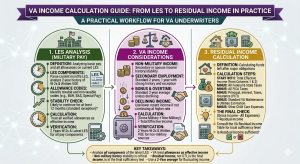
- Decide which income sources are usable under FHA, VA, Fannie, Freddie, or your overlays.
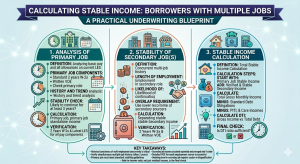
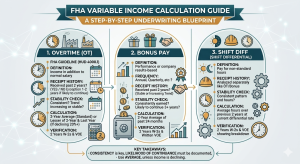
- Apply stability checks to variable income, multiple jobs, or self-employed borrowers.
- Produce a final qualifying income number that underwriting and investors can defend.
- Generate Smart Conditions that mirror underwriter thinking.
- Ensure consistency across channels, branches, and individual underwriters.
In other words, document AI answers: “What’s on the page?” Lenders and underwriters need: “What is the qualifying income, and what conditions must we clear?”
2. What is a dedicated income & conditions engine?
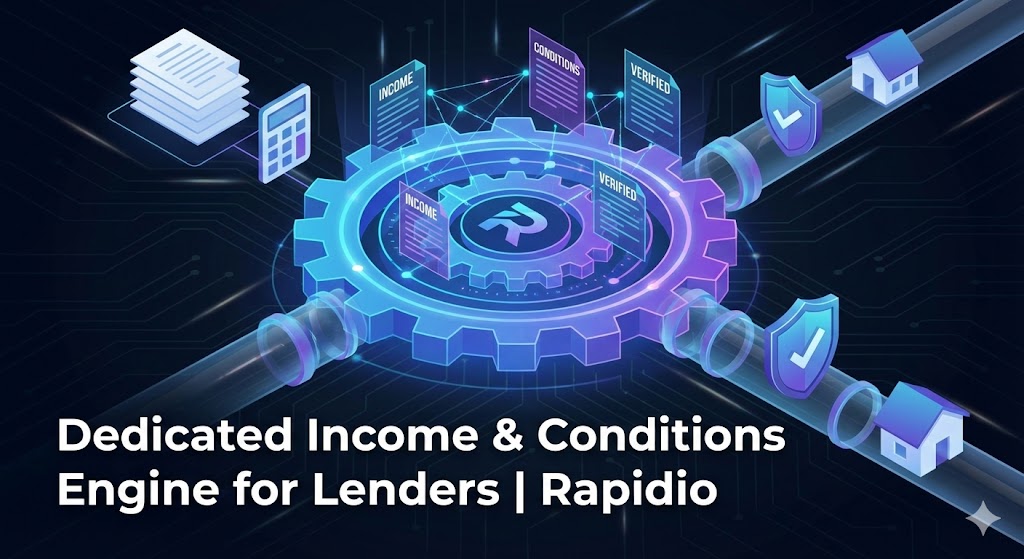
A dedicated income & conditions engine is a vertical AI layer that sits on top of documents and underneath your LOS, focused on one thing: turn every file into a consistent, guideline-ready income decision with clear conditions.
Concretely, an income & conditions engine should:
- Ingest all income-related documents: pay stubs, W-2s, 1099s, tax returns, bank statements, LES, SSA/pension letters, etc.
- Extract granular fields using AI + rules + human-in-the-loop QC.
- Apply guideline logic for FHA, VA, Fannie, Freddie, non-QM, DSCR, reverse and your overlays.
- Calculate qualifying income per borrower and income source with full math and lookback windows.
- Generate Smart Conditions for missing docs, gaps, declines, and inconsistencies.
- Output a standard report that LOs, processors, and underwriters can all rely on.
- Integrate with your LOS/POS/QC so the decision lives with the loan, not in someone’s spreadsheet.
3. Why separating docs from decisions hurts economics
3.1 Two systems, one job
In many organizations, document AI and income decisions are split: the AI pre-fills fields, then underwriters or processors rebuild income from scratch in Excel.
This creates an invisible tax on your economics:
- Duplicate work: “check the AI, then redo it to be safe.”
- Inconsistent logic from file to file and underwriter to underwriter.
- Little to no learning — the system never actually “gets smarter” about income.
3.2 Inconsistent conditions and surprise suspense
When decisions live in spreadsheets instead of a shared engine, conditions become highly personal:
- One underwriter asks for 24 months of history, another is fine with 12.
- One branch routinely misses a certain income red flag.
- Investors catch issues late, and you get surprise suspense or cures.
Without a common conditions engine, you’re essentially running different credit policies in parallel — and paying for it in rework and margin.
3.3 Training “heroes” instead of scaling a system
Complex income (self-employed, multiple businesses, reverse, niche products) often lives in the heads of a few senior underwriters. Document AI doesn’t change that.
As a result:
- New hires take months to become productive.
- Volume is constrained by “who can handle the hard files.”
- Leadership can’t easily model capacity and risk.
A dedicated engine codifies that expertise so it’s reusable and measurable, instead of locked inside individual spreadsheets.
4. How a dedicated engine changes life for your teams
The case for an income & conditions engine is not just technical. It’s about what every role experiences, every day.
4.1 Loan officers
- Get realistic, consistent income estimates earlier in the process.
- Fewer “sorry, UW changed the income” conversations with borrowers and agents.
- Better pull-through and fewer pricing surprises.
4.2 Processors
- Stop owning complex spreadsheets for every file.
- Use standard income reports as a checklist for what’s missing.
- Clear Smart Conditions before underwriting sees the file.
4.3 Underwriters
- Review and validate instead of rebuilding income from scratch.
- See full math and rationale for each income source.
- Spend time on risk and edge cases, not mechanical calculations.
4.4 Risk, QC, and executives
- Gain a single view of income decisions across the organization.
- Track defects, exceptions, and overrides by product, channel, or team.
- Model how changes in credit policy or overlays impact approvals and margin.
With a dedicated engine, “how we do income” stops being a rumor and becomes an asset you can manage.
5. Architecture: document AI + income & conditions layer
A modern mortgage stack doesn’t replace document AI; it layers an income & conditions engine on top.
A typical flow looks like this:
- Step 1 – Intake & document AI
Docs arrive from POS, brokers, or upload. Document AI classifies them and extracts raw fields. - Step 2 – Income & conditions engine
The engine consumes those fields (and sometimes raw docs), applies guideline logic, calculates qualifying income, and generates Smart Conditions. - Step 3 – LOS & workflow
Output is attached as a report and/or key fields are pushed into the LOS. Underwriters, processors, and QC use the same standardized view. - Step 4 – Analytics & feedback
Exceptions, overrides, and outcomes feed back into the engine to refine rules and insights.
This architecture lets you plug in the best document AI available, while keeping the credit-critical logic — income and conditions — in a specialized layer you control.
6. Build vs. buy: questions to ask
Some lenders consider building their own income & conditions logic on top of document AI. It’s possible — but before you commit, ask:
- Guideline maintenance: Who will keep FHA, VA, Fannie, Freddie, and product overlays up-to-date as they change?
- Edge cases: Who handles the long tail of messy income scenarios and exceptions?
- Human-in-the-loop: How will you embed QC review for risky files without creating another manual queue?
- Auditability: Can your internally built tools provide the same level of transparency to investors and auditors?
- Time-to-value: How long until your in-house engine is as robust as specialized vendors’?
For many organizations, the best path is buying the engine and configuring it, rather than rebuilding all of the domain logic from scratch.
7. Vendor checklist: spotting real engines vs. “AI wrappers”
When every vendor claims to offer “AI income automation,” it’s hard to tell who really has a dedicated engine. Use these questions:
- Vertical focus: Are they focused on mortgage income and conditions, or do they serve many unrelated industries?
- Guideline packs: Can they show you separate logic for FHA, VA, Fannie, Freddie, and niche products?
- Conditions engine: Do they produce underwriter-style conditions, or just generic flags and warnings?
- Explainability: Can you see and export full income calculations and rationale for each decision?
- Human-in-the-loop QC: Is there a controlled way to handle edge cases, or does everything fall back on your team?
- Proven ROI: Can they demonstrate improvements in time per file, suspense rates, or loans per underwriter?
- Integration model: How do they connect to your existing LOS/POS, and what does rollout actually look like?
Vendors who can’t answer these in detail are usually document AI platforms with some rules layered on top — not true income & conditions engines.
8. How Rapidio approaches the income & conditions engine
Rapidio is built specifically as a dedicated income & Smart Conditions engine for mortgage lenders and brokers.
- Mortgage-only focus: We live inside FHA, VA, Fannie, Freddie, reverse, DSCR, and other niche products.
- From income to conditions: Every file comes with qualifying income and Smart Conditions that mirror how underwriters think.
- Human-in-the-loop QC: Files are checked so you receive 100% reviewed, guideline-aware output.
- Fast time-to-value: Lenders and brokers can sign up, upload, and see real income decisions and conditions on their first files without a long IT project.
- Open architecture: Rapidio complements your existing document AI and LOS, rather than forcing a full re-platform.
Document AI is an important step. But if you want to truly change your economics, protect your margin, and scale without multiplying headcount, you need a dedicated income & conditions engine at the center of your stack.
Upload one complex loan — variable income, multiple jobs, or self-employed — and compare Rapidio’s income and Smart Conditions to your current process. See what changes when you go beyond document AI.