Building a “Clean File First” Workflow: Income & Smart Conditions at the Center
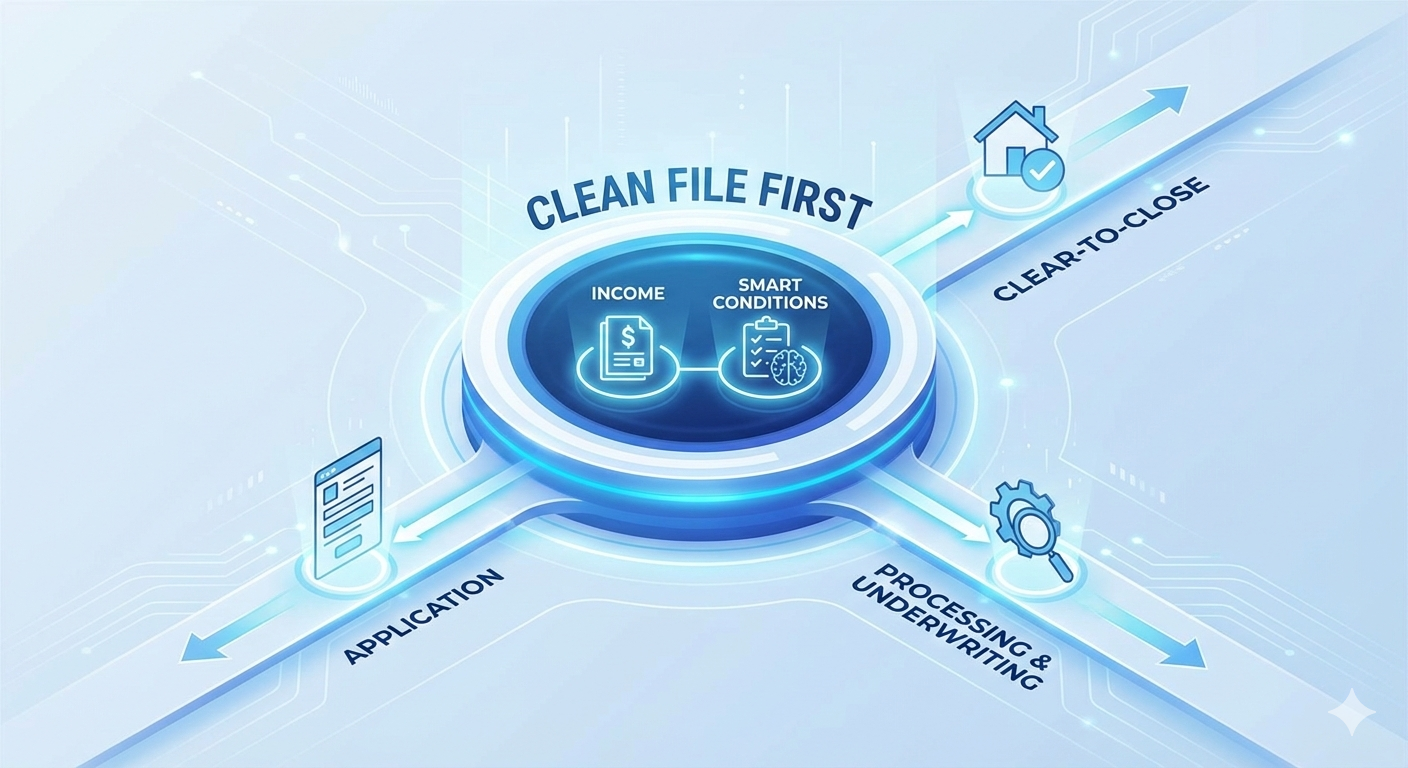
“Clean File First” means underwriting doesn’t become a detective story. It’s a workflow where income is calculated early, conditions are generated automatically, and your team clears the right items before the file ever hits the underwriting queue. The result: fewer touches, less suspense, and faster CTC - without sacrificing quality.
1. What “Clean File First” actually means
“Clean File First” is not “perfect files.” It’s a repeatable standard: before underwriting reviews a loan, the file already has:
- A guideline-aware income calculation (not an LO guess).
- A clear list of Smart Conditions based on that income.
- Documents collected to clear the highest-impact conditions.
- A standardized report that a UW can validate quickly.
2. Why files get “dirty” (and where it costs you)
“Dirty files” usually happen for predictable reasons:
- Income is estimated early and corrected late.
- Conditions are discovered only after a UW looks at the file.
- Different people apply different interpretations, creating rework loops.
- Borrowers drip-feed documents, and no one has a clear checklist.
| Dirty File Symptom | What It Causes | What It Costs You |
|---|---|---|
| Income uncertainty | UW rebuilds income; back-and-forth clarifications | More UW minutes + longer queues |
| Late conditions | Suspense cycles, delays, missed closing dates | Cycle time + borrower/Realtor frustration |
| Inconsistent treatment | Different results per UW/branch | Rework + QC defects |
| Doc churn | “One more doc” every few days | Touches + lost velocity |
3. The Clean File First blueprint (step-by-step)
Here’s a simple blueprint you can implement without a massive tech project. The core idea: run income early, generate Smart Conditions, clear the highest-impact items, and only then send the file into the underwriting queue.
Run income automation at intake
As soon as income docs arrive, calculate qualifying income using guideline-aware logic and a standard report.
Generate Smart Conditions immediately
Missing docs, gaps, declines, inconsistencies - flagged right away, not after a UW discovers them days later.
Clear “high-impact” items first
Prioritize conditions that typically create suspense: history windows, missing returns, verification proof, gaps.
Send a clean file to underwriting
Underwriting reviews a standardized income report and validated conditions - not a mystery box of docs.
4. Why income + Smart Conditions belong at the center
Many lenders try to build “clean files” by pushing processors to request more documents early. The problem: without an income engine, teams often request the wrong things or too much.
Income automation + Smart Conditions solve that by producing:
- Precision: request exactly what underwriting will require.
- Consistency: same income logic and condition language across teams.
- Speed: fewer loops, fewer surprises, faster movement to CTC.
It’s the difference between “collect everything” and “collect what matters.”
5. How to reduce handoffs and touches
Cost per loan is driven by touches. Clean File First works when you reduce handoffs like:
- Processor builds income worksheet → UW rebuilds → processor revises → UW rechecks
- Conditions discovered late → borrower sends docs → UW re-reviews
With a standardized income report + Smart Conditions, teams share one source of truth, and conditions are cleared upstream - reducing the number of “re-open the file” moments.
6. KPIs to measure: what improves when files get cleaner
Track these before and after you implement Clean File First:
- Underwriter minutes per file (income portion)
- Income-driven suspense rate + average days in suspense
- Touches per file (re-review count)
- Time from application to initial UW decision
- Time from conditional approval to CTC
- Income-related defects / cures
7. Implementation plan: how to roll out in 2–4 weeks
You don’t need a 6-month integration to start. A realistic rollout looks like:
- Pilot on 20–50 loans (include complex income).
- Define a standard report as the “income source of truth.”
- Align condition language with your underwriting team.
- Train processors to clear top Smart Conditions before UW.
- Measure KPIs (touches, suspense, UW minutes, time-to-CTC).
- Scale by channel/branch once metrics improve.
When executed this way, Clean File First becomes a repeatable production system - not a slogan.
Pick 10 recent loans that created suspense or extra rework. Run them through Rapidio and compare: the income report, Smart Conditions, and how many touches could have been avoided.